What we are trying to understand
RIfT makes the strongest claims its work can support, keeps them capable of being wrong, and is explicit about where its knowledge runs out. This page shows all three.
Read the argument: Why transformation?Claims for which RIfT finds substantial support in existing research and in its own work.
- Institutions form people.
- Colonial and imperial histories continue to shape contemporary institutions and the knowledge they treat as authoritative.
- Systems produce incentives for their own reproduction.
- People adapt to harmful conditions in ways institutions later read as traits of those people.
- Institutions can absorb critique without being transformed by it.
Working propositions emerging from the research. They are contestable by design and open to revision.
A system’s capacity to reproduce itself may depend partly on making participation in its continuation feel safer than participation in its transformation.
People’s difficulty living within a system can be knowledge about the system.
An institution has not transformed because it has learned something about itself. Transformation requires what becomes known to become consequential.
The questions guiding the research this season. They will change as the research does.
System formation
- What kinds of people do our institutions require in order to continue being themselves?
- What do people learn they must become in order to belong?
- What happens when the people a transformation requires are different from the people the existing system has formed?
System reproduction
- Why do people reproduce systems they consciously recognise as harmful?
- How do security, income, belonging, legitimacy and identity become attached to a system’s continuation?
- When does participating in transformation become more dangerous than participating in continuation?
Relational recognition
- When is someone’s difficulty treated as information about them, and when can it become knowledge about the architecture?
- What allows contradiction to become recognisable rather than individualised, denied, metabolised or harmlessly incorporated?
- Who has the authority to decide what an experience means?
Position and risk
- Who is being asked to risk what for transformation to become possible?
- How does someone’s position affect their capacity to speak, refuse, leave or act?
- Who carries the risks when transformation does not happen?
Return and answerability
- What allows lived experience to travel back into institutional decision-making?
- What prevents institutions from learning without changing?
- When does listening become consequential?
Transformation
- How can we distinguish transformation from adaptation, accommodation, improvement or breakdown?
- What must become consequential for a system to become capable of being different?
- Can a desired future be specified before transformation begins, or does transformation change the standpoint from which that future was imagined?
Initiation and threshold
- What can rites of passage teach us about systemic transformation without turning them into another change methodology?
- What capacities are needed when transformation threatens identity, certainty, belonging or status?
- What allows people and institutions to return differently rather than rebuild what existed before?
History and inheritance
- Which colonial, imperial and extractive logics remain active in contemporary institutional architecture?
- How can we distinguish historical inheritance from claims too broad to investigate?
- What would it mean for institutions to meet what they have inherited without turning decolonisation into metaphor?
Relational Architecture
RIfT’s research programme: what institutions teach people to become through their relationships, rules, permissions and exclusions, and whether what people learn there can return and transform the institution.
VocabularyHow systems reproduce
Formation, security, belonging, identity and power: the conditions that make continuation feel safer than transformation.
Emerging patterns, not settled theory: the ways institutions close a contradiction before it can be recognised, by individualising, metabolising, denying or harmlessly incorporating it.
Formation and education
What our institutions, schools among them, prepare people to become, and what happens when the people a transformation needs differ from the people a system has formed.
Return and answerability
Whether what becomes known inside an institution can travel back far enough to change the conditions that produced it, and what it takes for listening to become consequential.
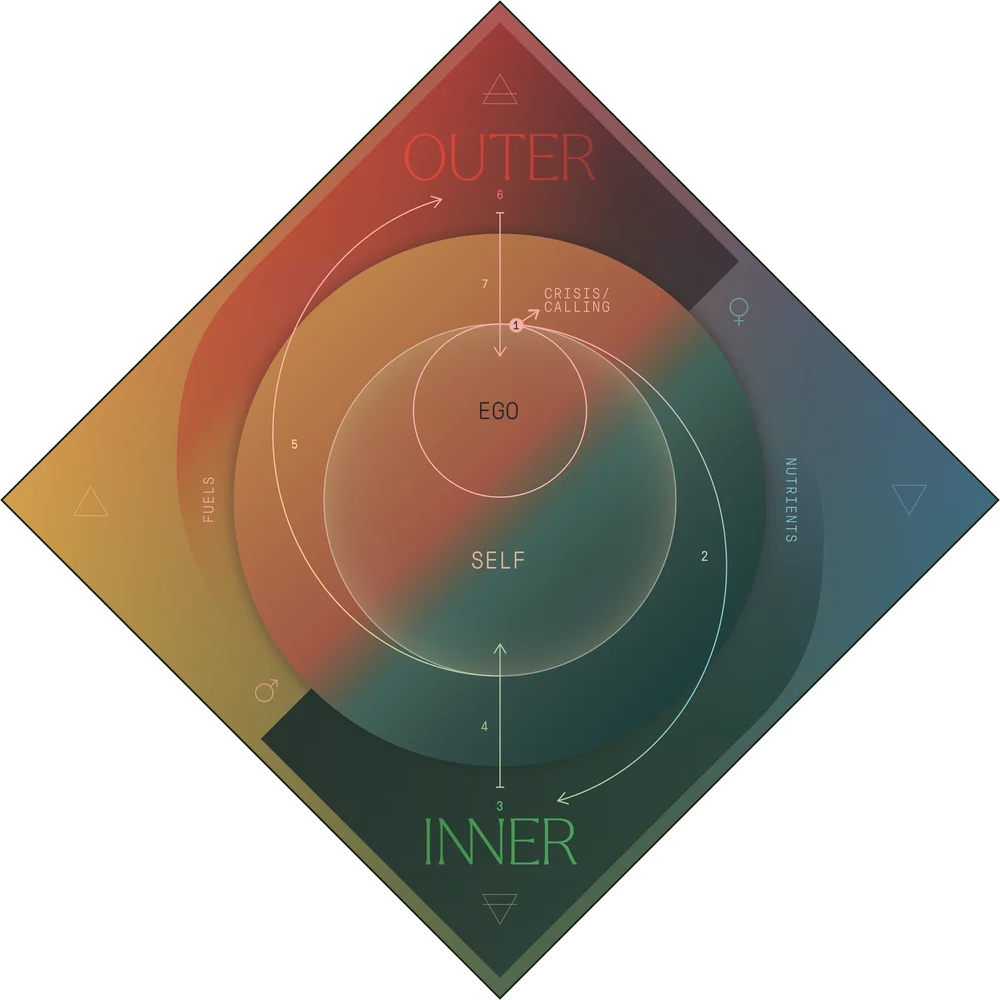
The Soul of Change
Transformation is not only something we do. It is something we undergo.
The Soul of Change describes a movement that turns throughout our lives, in large circles and small ones. A crisis or calling interrupts an existing form. In the descent, what once gave orientation begins to loosen before the new is yet known. Rebirth asks for patience and presence. Return asks what can now be brought back into relationship with the world.
It is offered as a map rather than a method. In RIfT’s research it raises a sharper institutional question: when a threshold can cost people status, belonging, identity or income, who is being asked to carry that cost, and can the institution receive the person who comes back changed?
Working Paper Series
The Missing Account of Institutional Formation
Why organisational change theory struggles to account for transformation
Organisations routinely describe change programmes as transformational, yet influential theories of organisational change offer limited agreement about what transformation is or how we would know whether it has occurred. This paper argues that part of the problem is a missing theoretical object: institutional formation. Institutions do not merely provide settings in which people change; through repeated relationships, permissions, obligations and patterns of participation, they participate in forming perception, identity, agency and responsibility. The paper develops Relational Architecture as a way of examining these formative conditions and proposes that institutional transformation requires not only changing people or practices, but altering the relational conditions through which an institution forms people, distributes agency and becomes answerable to those affected by its actions.
The Working Paper Series develops RIfT’s inquiry one question at a time. Each paper makes a bounded contribution to a larger research programme and is published to invite dialogue, criticism and refinement.
We announce papers when they are ready rather than in advance. The programme will evolve as the research meets criticism, evidence, practice and its own limitations.
RIfT cites its lineage as kin, not as borrowed authority. Each paper names its sources and what it takes from them.
- Vanessa Machado de Oliveira — the register for facing complicity without moralism, and for what it means to stop sustaining what is causing harm.
- Linda Tuhiwai Smith — how research, classification and institutions carry colonial logics after formal colonial rule has ended.
- Gloria Anzaldúa — nepantla, the unstable in-between where inherited categories no longer hold.
- Paulo Freire — education for adaptation versus education for critical perception and transformation.
- Research Institute for Sustainability (RIFS) — discussion papers on how psychological and institutional conditions reproduce the systems people oppose.